
Over the years, I have heard many people and listened to numerous podcasts that attempt to explain why they believe the Earth is flat. They cite various observations, such as the apparent fixed position of Polaris, unchanging star patterns over millennia, and the lack of any felt motion from Earth’s supposed spinning and orbiting, as evidence against the globe model.
Flat Earth proponents frequently cite observations of the night sky as evidence for their model. They point to prominent constellations such as the Big Dipper, Orion, and the Pleiades, along with the visible band of the Milky Way, noting that these patterns have remained essentially unchanged since the time of ancient civilizations like the Sumerians and Egyptians. A central focus is Polaris, the North Star, which appears motionless and fixed in the northern sky, serving as a reliable navigational reference for centuries. They argue that if Earth were spinning at roughly 1,000 mph at the equator, orbiting the Sun at 66,600 mph, and moving through the galaxy at far greater speeds, such perfect consistency in star positions over thousands of years would be impossible. They often use time-lapse photography to demonstrate that the stars appear to rotate in an orderly manner around a stationary Polaris positioned above the North Pole, which they interpret as evidence that Earth is not spinning or hurtling through space.
The Night Sky’s Timeless Dance: Why Polaris and Star Trails Show a Rotating Earth
The good news is that the very observations, especially time-lapse photos of star trails centered on Polaris, actually confirm the standard scientific picture: Earth is a spinning sphere orbiting the Sun in a vast universe. Here is why:
Polaris: The Almost Perfectly Fixed North Star
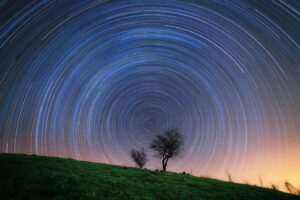
Polaris (the North Star) appears nearly motionless because it sits almost directly above Earth’s North Pole, the point where our planet’s imaginary spin axis meets the sky.
Imagine Earth as a giant spinning top. The top has an axis (the rod through its center). If you look straight down that axis from above, the rod does not appear to move. Polaris is very close to that celestial “rod tip” in the northern sky. All the other stars trace large circles around it as Earth rotates once every 24 hours. That is exactly what long-exposure photographs show: beautiful concentric arcs of light centered on one steady point.
These star-trail photos are real and repeatable. They match what anyone with a camera on a tripod can capture on a clear night. The slight wobble of Polaris itself (it traces a tiny circle) is because it is not exactly at the pole, but it is close enough to have guided navigators for centuries.
Star Trails in the South: The Other Side of the Story
If Earth were flat and stationary with stars circling overhead like a dome, star trails should look similar everywhere. They do not.
In the Southern Hemisphere, stars circle a completely different point, the South Celestial Pole, where there is no bright “South Star” like Polaris. Time-lapse photos from Australia, South America, or Antarctica show beautiful circular trails centered on that southern point with no Polaris in site. This geometry only makes sense on a rotating globe.
Different Spin Speeds: Fast at the Equator, Still at the Poles
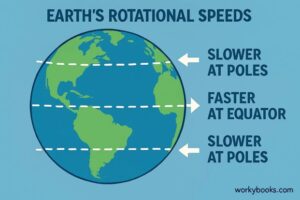
Earth spins once every 24 hours, but different parts of the planet move at different speeds because of its spherical shape. At the equator (the middle “belt”), the surface has to travel the full circumference of the Earth (about 25,000 miles) in one day. That works out to roughly 1,000 miles per hour. Near the North or South Pole, you are standing almost on the “axis” of the spin, so you barely move at all. This is like the center of a merry-go-round compared to the outer edge.
You can picture this with a simple analogy. Grab a basketball or globe and spin it slowly. A sticker near the middle (equator) flies around fast. A sticker right on the top or bottom (poles) hardly moves. This difference is real and measurable. Clocks, airplanes, and even the shape of the Earth itself show it. The planet is a tiny bit wider at the equator because the spin creates a small outward push there. Flat Earth models cannot explain why the rotation speed changes smoothly with latitude in exactly this way.
Why Don’t We Feel Earth Spinning at 1,000 mph?
This is one of the most intuitive questions. The answer lies in two everyday ideas: constant speed and inertia.
Inertia is the tendency of objects to keep doing what they are already doing unless something pushes or pulls them. A ball rolling on a smooth floor keeps rolling until friction or a wall stops it.
Earth’s rotation is extremely smooth and has been happening for thousands of years. Everything on the surface (air, oceans, you, your house) is moving with the Earth at the same speed. There is no sudden start or stop, so there is nothing to feel.
Think of a smooth airplane flight at cruising speed. (I was a flight attendant and the plane was my office!) You can walk the aisle, pour a drink, or sleep without noticing the hundreds of miles per hour. You only feel changes in speed (acceleration or deceleration) or direction (turning or turbulence). Earth’s rotation gives a very gentle, steady outward push at the equator (called centrifugal effect), but it is tiny compared with gravity pulling us down. We do not notice it.
The same principle applies to Earth’s orbit around the Sun (about 67,000 mph) and the whole solar system’s motion through the galaxy. Everything moves together in a smooth, shared reference frame.
Seeing the Curve from a Ship at Sea
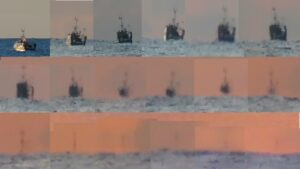
One of the oldest and simplest ways to see Earth’s curvature is by watching a ship sail away over the horizon. From the beach or a low deck, you first notice the ship’s hull disappearing below the water line while the sails or upper parts are still visible. As it gets farther, even the top of the ship eventually sinks below the horizon. This happens because the surface of the ocean curves gently downward, hiding the lower parts first.
If Earth were flat, the entire ship would simply shrink smaller and smaller until it became too tiny to see, but the hull and sails would disappear together. Binoculars or a telescope bring back the upper parts but not the hidden hull. This is clear proof the ship has gone over the curve. This same effect is why you can only see so far at sea and why taller observation decks (like on a ship’s mast or a lighthouse) let you see farther. Ancient sailors noticed this long before modern science.[1]
Parallax: How We Know Earth Orbits the Sun
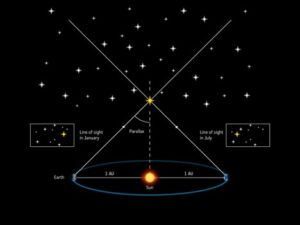
One powerful piece of evidence comes from stellar parallax, the apparent shift in a nearby star’s position against more distant background stars when viewed from two different places.
Here is a simple everyday version: Hold your thumb at arm’s length and close one eye, then switch eyes. Your thumb appears to jump against the background. That jump is parallax. The closer your thumb (or the star), the bigger the shift.
Earth does the same thing naturally. Every six months it is on opposite sides of its orbit around the Sun, about 186 million miles apart. Astronomers measure the tiny shift in nearby stars’ positions. The shift is tiny because stars are incredibly far away, but it has been measured since the 1830s and is now done routinely with telescopes and satellites. This proves Earth is moving in a large orbit.
Without Earth orbiting the Sun, there would be no annual parallax. [2]
Foucault’s Pendulum: Watching Earth Turn Under Our Feet
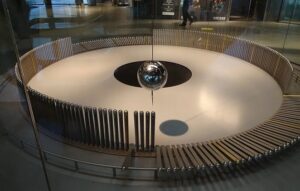
The Foucault pendulum is a simple experiment that proves Earth rotates. In 1851, French physicist Léon Foucault hung a long, heavy pendulum and set it swinging in a straight line. As hours passed, the direction of its swing slowly rotated on its own, not because the pendulum changed direction, but because the Earth was turning underneath it while the pendulum’s swing stayed fixed in space due to inertia.
At Paris’s latitude, it takes about 32 hours for the swing to complete a full circle. At the North Pole it would take 24 hours, and at the equator it does not rotate at all.
Many science museums still have working Foucault pendulums. You can watch the Earth rotate in real time. [3]
The Coriolis Effect: Rotation You Can See in Weather
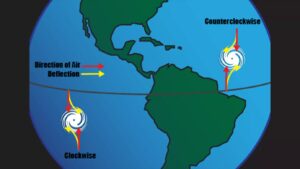
Earth’s rotation also gently deflects moving objects (winds, ocean currents, and even long-range artillery shells). This is called the Coriolis effect.
In the Northern Hemisphere, moving air is deflected to the right; in the Southern Hemisphere, to the left. That is why hurricanes and cyclones spin counterclockwise north of the equator and clockwise south of it. It is a direct, measurable consequence of living on a rotating sphere. Flat or stationary-Earth models cannot produce this consistent, opposite rotation in the two hemispheres.[4]
Ancient Constellations and Vast Distances
Why do constellations look essentially the same as they did to the Sumerians or Egyptians thousands of years ago? That is because even the nearest stars are light-years away. The distances are so enormous that their positions change only very slowly (proper motion). Over human history the patterns are stable, exactly as expected.
Polaris itself is roughly 323 to 433 light-years away. The next-nearest star system is over 4 light-years distant. These numbers sound mind-boggling, but they are measured consistently by multiple independent methods (parallax for nearby stars, then other techniques for farther ones).
Putting It All Together
The observations of flat earthers (Polaris staying put, beautiful circular star trails, unchanging ancient constellations) are not problems for the standard model. They are predictions of it. The same laws that keep Polaris nearly fixed also let us predict eclipses centuries ahead. A rotating spherical Earth with its axis pointing near Polaris naturally produces exactly these skies. Additional independent evidence (Foucault pendulums, Coriolis effect, stellar parallax, satellite imagery, GPS, seasons, eclipses, and gravity measurements) all line up consistently. A book could be written detailing many more examples that can only be explained with the heliocentric model of our solar system and a spherical spinning earth.
Science does not remove the wonder; it deepens it. The universe is far larger and more elegantly ordered than a simple dome would allow.
If you enjoy looking up at night, keep doing it. Try capturing your own star trails with a phone or camera on a tripod. Visit a planetarium or science museum with a Foucault pendulum. Ask questions. The sky rewards patient observers.
The night sky has been inspiring people for millennia. The more we understand how it works, the more magnificent it becomes.
Keep looking up!
Psalm 19:1- The heavens declare the glory of God; and the firmament sheweth his handywork.
Christian Astronauts
Apollo 8 (1968) – The Famous Genesis Reading
On Christmas Eve 1968, while orbiting the Moon, astronauts Frank Borman, Jim Lovell, and Bill Anders took turns reading the first 10 verses of Genesis 1 (KJV) during a live broadcast watched by hundreds of millions:
- Bill Anders: “In the beginning God created the heaven and the earth. And the earth was without form, and void; and darkness was upon the face of the deep. And the Spirit of God moved upon the face of the waters. And God said, Let there be light: and there was light. And God saw the light, that it was good: and God divided the light from the darkness.”
- Jim Lovell continued with verses about day/night and the firmament.
- Frank Borman finished: “…And God called the dry land Earth; and the gathering together of the waters called the Seas: and God saw that it was good.”
This was one of the most iconic moments of early space exploration.
Apollo 11 (1969) – Buzz Aldrin on the Moon
Buzz Aldrin (the second person to walk on the Moon) privately celebrated Communion in the Lunar Module shortly after landing. He read John 15:5 (“I am the vine, you are the branches. Whoever remains in me, and I in him, will bear much fruit; for you can do nothing without me.”) from a card he carried. He also referenced Psalm 8:3-4 (“When I consider thy heavens, the work of thy fingers, the moon and the stars, which thou hast ordained; What is man, that thou art mindful of him?”).
The first food and drink consumed on the Moon were the communion elements.
Apollo 15 (1971) – James Irwin
James Irwin quoted from the Psalms while on the lunar surface, reflecting on the wonder of creation (specific verses often cited include Psalm 8 or similar passages about the heavens declaring God’s glory).
Victor Glover (ISS and Artemis II)
Victor Glover has openly shared faith messages from space, quoting or referencing Scripture (including themes from the Gospels, such as loving God and neighbor from Matthew 22:37-39), and has taken a Bible with him on missions.
Blue Marble – Apollo 17 (1972)
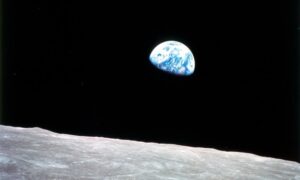
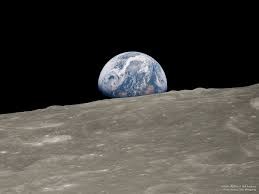
Taken by the Apollo 17 crew, this is one of the first (and still one of the most famous) full-disk photographs of Earth. It shows our planet as a complete, beautiful blue sphere suspended in space.
For more in-depth information, a wonderful resource is the Biblical Science Institute (biblicalscienceinstitute.com), founded by Dr. Jason Lisle, a Christian astrophysicist.
Is the Earth Really Round? | Biblical Science Institute
Debunking Flat-Earth Claims | Biblical Science Institute
Debunking Flat-Earth Claims – Part 2 | Biblical Science Institute
Debunking Flat-Earth Claims – Part 3 | Biblical Science Institute
Untwisting Scripture: Refuting Flat Earth Falsehoods – Part 1 | Biblical Science Institute
[1] kiwihellenist.blogspot.com
Kiwi Hellenist: Detecting the earth’s curvature
What Is Parallax? – How Astronomers Measure Stellar Distance | Space
How Does Foucault’s Pendulum Prove the Earth Rotates?
What Is the Coriolis Effect? | NESDIS | National Environmental Satellite, Data, and Information Service