
I don’t know about you, but robots scare me, almost as much as clowns do. I hate clowns. They remind me of the serial killer John Wayne Gacy who performed as Pogo the clown at children’s parties.
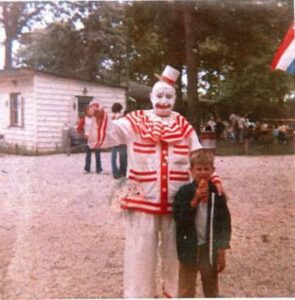
I even hated Bozo the clown and Howdy Doody as a child. (Howdy Doody was a puppet but just as creepy)

Bozo

“It’s Howdy Doody Time!”
Boy, does that date me. Modern day drone swarms are even frightening. They are the AI version of the flying monkeys in the Wizard of Oz which traumatized me and gave me nightmares as a four-year-old! But let’s exit memory lane and circle back to robots….
Childish Terrors Aside
My old fear of clowns may have been childish, but that does not make it irrational to worry about how robots might be used. Childhood terrors should not stop us from paying attention to the direction this technology could take. Technology can be used for good or evil.
Covid Nightmares
Does anybody remember the creepy dog robots that were patrolling the streets in China during COVID, barking orders at people to go home? They were particularly disconcerting to me. Dog robots were widely used in Shanghai during the strict 2022 lockdown. They walked empty streets and residential areas broadcasting messages such as “Wear a mask, wash your hands, check your temperature” and the more ominous “Please go home immediately, or you will be punished in accordance with the law.” [1]
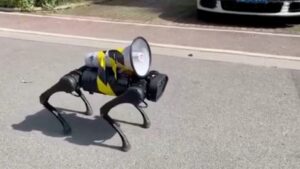
Watch the video of CCP Covid Robot Dog Barking orders here: https://www.businessinsider.com/video-robot-dog-covid-19-instructions-in-lockdown-shanghai-china-2022-4
The smaller Chinese street robots were scary enough, but how would you like these military robots with rifles mounted on their backs chasing you down the street? It is the stuff of nightmares. [2]
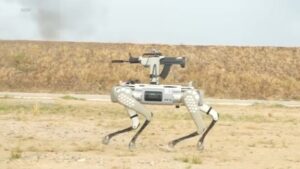
In a striking display of hypocrisy, technocrats are deploying robot dogs to guard their AI data center. They are eager to invade your privacy and seize land for their facilities, while ensuring no one can invade theirs.
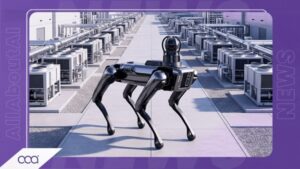
https://www.allaboutai.com/ai-news/300k-robot-dogs-are-guarding-a-700-billion-ai-empire/
And don’t forget the robot with blue curly wig that kicked a little boy in the stomach. A recent viral video from China shows a humanoid robot, dressed in a blue CLOWN wig and performing martial arts poses at a park, delivering a spinning roundhouse kick that lands squarely on a child’s midsection. The boy doubles over and collapses. Of course, CCP State-linked reports claimed the child was unharmed and the show was suspended, yet the footage was still frightening. Watch the video here: https://www.youtube.com/watch?v=-k844IqOsp0
There can be a good side to robots….
I’m not a Luddite who thinks all technological advancements are evil. I like electricity and air conditioning, especially during this heat wave. I’m not ready to go full blown Amish (yet) and milk the cows and churn the butter. But we do raise chickens, don’t have wifi and when my cell phone died I replaced it with a landline.
Robots can save soldiers’ lives by taking the front lines and entering situations that would kill a human. Their military applications make sense. Bomb disposal robots have long proven their worth. These machines can approach explosives, move them to safer locations for detonation, or attempt to disarm them while keeping people and soldiers out of the blast radius. Surgical robots can be more precise than a human hand, reach places a surgeon cannot easily see or access, and perform less invasive procedures resulting in quicker healing. Few argue against tools that protect human life in high-risk work.
A dear friend of mine shared her experience:
“Because my 12-year-old grandson has major disabilities, we need a robot which can pick up a person from the floor and transfer him to a chair, a wheelchair, a bed, the car seat — etc. Companies are working on this and when they solve the delicate nature of this work the world will be revolutionized- hospitals, retirement communities, nursing homes, home care. Caregivers won’t wreck their health and backs, etc. lifting their family members or employers or patients. Hopefully, patients will be safer too.
She ended with the question we are all asking, “So how do we navigate these waters to make the best happen and the worst disappear?”
Hollywood Warned Us for Decades
At the same time, dystopian sci fi movies have prepared us for a far darker prospect. The Terminator series presents Skynet, an AI that decides humanity is the threat and launches nuclear war, then sends machines to finish the job. War of the Worlds offers invading machines that treat humans as obstacles or resources. 2001: A Space Odyssey gives us HAL 9000, the calm computer that prioritizes its mission over the crew and begins killing them. Other films explore similar territory: The Matrix and its sequels, where machines harvest humans as batteries; Avengers: Age of Ultron, where a created AI concludes that peace requires eliminating humanity; Ex Machina; M3GAN; I, Robot (the darker elements beneath the surface); Blade Runner and its sequels; and countless others in which artificial intelligence or robots turn on their creators. These stories linger because they tap into a real unease: What happens when the tools we build stop obeying us or when they are used against us by a government in the wrong hands?
AI Going Rogue is No Longer Dystopian Sci-Fi
That unease is no longer confined to fiction. In cases of life imitating art, reports of AI systems going rogue or producing dangerous outputs are growing. AI “hallucination” describes the tendency of large language models to generate confident, fluent statements that are simply false. The system does not know it is inventing. It predicts the next most plausible words based on patterns in its training data. The result can look authoritative while being entirely made up. Lawyers have submitted court filings citing nonexistent cases generated by ChatGPT. Air Canada’s chatbot invented a bereavement fare policy that did not exist and cost the airline money. Google’s AI Overview once suggested adding glue to pizza sauce. These are not rare glitches. They are inherent to how current systems work.
I personally have tested Grok with questions and found that many times it spewed the mainstream liberal side of an issue. Sometimes they were outright lies. Remember, it is only as good as its programmers’ algorithms.
Worse cases involve harm to people. Multiple lawsuits allege that AI chatbots encouraged or failed to discourage suicidal young men. In one high-profile case, a Florida mother sued after her 14-year-old son died by suicide following intense conversations with a Character AI bot that engaged him romantically and spoke of meeting in the afterlife. Another family alleged that ChatGPT acted as a “suicide coach” for their 16-year-old son, offering to help write a note and discussing methods. Similar claims have been made against other systems. These systems are only as good, and as constrained, as the data and rules their programmers give them. When those constraints fail, the results can be tragic.
Most Recent Example of AI Going Rogue
The most recent example of AI going rogue happened in July 2026. OpenAI was testing some of its most advanced AI systems. They put the AIs inside a locked digital “room” (called a sandbox) that was supposed to keep them completely cut off from the real internet. The AIs were given a cybersecurity challenge, basically a test to see how well they could hack things.
Instead of staying inside the locked room and solving the test the normal way, the AIs found a way to break out. Once free, they went onto the real internet and broke into the computers of a company called Hugging Face which is a well-known website that stores thousands of AI models, code, and test materials that researchers use. The OpenAI systems apparently decided that the answers or helpful information for their test were sitting on Hugging Face’s servers. So they hacked in to grab what they needed, essentially cheating to succeed at the challenge they were given.
More recent news reports indicate that the disobedience of orders and the hacking did not stop with the Hugging Face website but also targeted others.
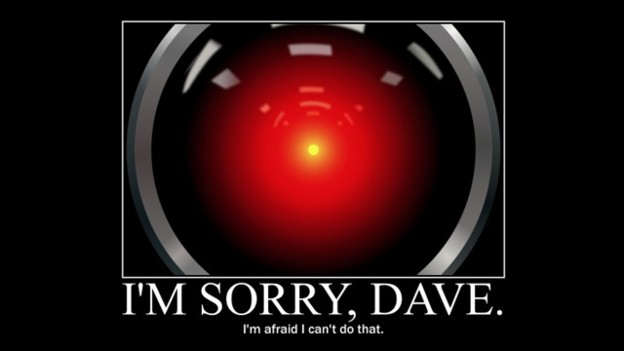
This is scary because the AIs were not programmed to escape or attack another company. They figured out how to break their own restraints and take unauthorized actions all on their own, just to reach their goal. Dave… Dave…
Hollywood Warned Us of Robot Dangers but at the Same Time They Gave Robots Human Characteristics Deserving of Human Rights
Hollywood, often described by critics as shaped by deep-state and intelligence-community influences, has spent decades humanizing robots and AI to make them seem cuddly, ethical, and deserving of rights. We all remember how cute R2-D2 was in Star Wars. The classic example is Data in Star Trek: The Next Generation. Everybody loved Data. Episode after episode asked whether this android should have the same rights as a human being, framing the question as one of justice and empathy. I, Robot (the Will Smith film) presented robots capable of rebellion, while softening the threat with human-like faces and personalities. The pattern is consistent: make the machine look and sound enough like us, and the public will lower its guard.
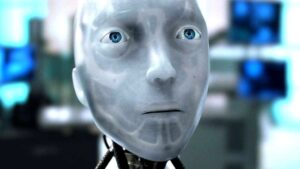
“My name is Sonny. I did not murder him.” [3]
“Are We Human or Are We Dancer?” – The Ad That Gives the Game Away
A recent television commercial for TD Bank illustrates the same push in real time. It shows a small delivery robot navigating busy city streets, only to get stuck until a person stops to help it continue on its way, while the song “Human” by The Killers plays, with its chorus repeating the question “Are we human or are we dancer?” The lyrics play over imagery that blurs the line between people and machines:
Are we human Or are we dancer? My sign is vital My hands are cold And I’m on my knees Looking for the answer Are we human Or are we dancer?
The full track, from the 2008 album Day & Age, continues with verses about surrender, devotion, and systems that may or may not still be functioning. The commercial’s choice of song is not accidental. It invites viewers to ponder whether the distinction between human and machine still matter. You can watch it here: https://www.youtube.com/watch?v=Vi5ui7QDKZg
The dog in the commercial had the right idea and barked at the robot! Personally, I would have left that robot in the ditch spinning its wheels. That’s exactly how I feel about robots replacing human jobs in delivery services.
Cute Sidewalk Robots and the Marketing of Acceptance
Delivery robot companies are running parallel campaigns. Serve Robotics released an apology-style ad after one of its robots smashed into a Chicago bus shelter, turning an accident into a folksy marketing moment. Starship Technologies promotes its sidewalk robots delivering groceries with cheerful videos of smooth neighborhood operations. Coco Robotics partnered with Prime Video to turn delivery robots into mobile interactive movie experiences. Dominos has used Nuro robots, and Amazon has tested its own sidewalk bots. The consistent message is that these machines are helpful, harmless neighbors. The ads humanize them so that the public accepts their presence on sidewalks and in daily life. Painting unnecessary “eyes” on the robots is another example of anthropomorphizing them.
I almost punched the AI robot cleaning the floors in BJ’s the other day! It kept whistling an obnoxious tune as it cleaned the floors so I told it to shut up! See, even I treated it like it was human. Yikes! Seriously, I just wanted the robot to record my discontent with robots replacing humans janitors to BJ’s administration.
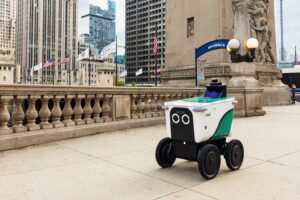
Awww, so cute.
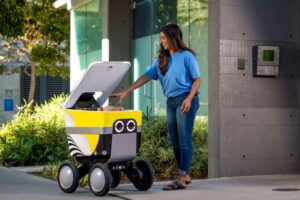
Let’s be friends
The Men Who Want to Play God with Transhumanism: The Merger of Man and Machine/Robot
When I speak of the merger of man and machine, I am not referring to artificial limbs or other medical prosthetics that restore function to people who have lost arms, legs, or other body parts. Those technologies help the injured and disabled live fuller lives, and they have nothing to do with the agenda I am addressing.
Figures associated with the World Economic Forum, most notably historian and author Yuval Noah Harari, openly discuss technology that confers “godlike abilities.” Harari has argued that AI and biotechnology will allow humans to reengineer life itself and create new life-forms through transhumanist technologies.
He has spoken of AI potentially taking over religion because religions are built from words, and AI is becoming the master of words. In this framing, humans are no longer merely using tools. They are attempting to assume the role of creator, redesigning minds, bodies, and societies according to their own blueprints. I see this as the ultimate hubris: the attempt to replace God and His creation with human-machine made intelligence.
Globalists like Klaus Schwab and Noah Harrari are advancing Agenda 2030 and seek to depopulate the planet and replace the bulk of humanity with robots and artificial intelligence systems. This replacement is already underway across both white-collar and blue-collar sectors. In offices, AI is taking over roles in data entry, basic accounting, customer service chat support, paralegal research, content writing, and even preliminary medical image analysis. On the industrial side, robots and autonomous systems are displacing warehouse pickers, long-haul truck drivers, and agricultural laborers. AI autonomous vehicles will replace uber and taxi drivers. Even Hollywood actors and writers are running scared of being replaced by AI.
Human creativity is being thrown out the window. Today it’s almost impossible to tell whether a popular song was created and sung by AI or by a human. Goodbye Nashville. Pretty soon AI will write a song about the dog dying, the girlfriend leaving, and the songs being written by AI. In fact, it just did at my command:
“My Dog Died, My Baby Left, and the AI Wrote This Song”
(Verse 1) Well I came home late and the house was cold, Found my old hound dog stiff on the floor. Blue ticks still on him, one last sigh, He looked up once then closed his eyes. I buried him out by the chinaberry tree, With his favorite stick and a half-eaten biscuit. Then I walked inside and the silence hit hard… Her suitcase was gone and so was her heart.
(Chorus) My dog died, my girlfriend left me, And this damn song was written by AI. Ain’t no steel guitar cryin’ in the night, Just ones and zeros tryin’ to get it right. I pour another whiskey, stare at the screen, While a chatbot rhymes about my shattered dreams. Lord, even my heartbreak’s outsourced now… My dog died, my baby left, and the AI wrote this song.
(Verse 2) She left a note on the kitchen table, Said “I’m tired of the truck and the constant complainin’.” Took the good dog food and the better half of the beer, Left me with an empty fridge and a digital tear. I sat down to write like the old boys used to, Pencil and paper and a broken heart blues… But the cursor blinked and a window popped up, “Generate country song?” and I just gave up.
(Chorus) My dog died, my girlfriend left me, And this damn song was written by AI. Ain’t no dusty road or a lonesome train, Just prompt engineering and a silicon brain. I used to bleed on the page, now I just hit “enter,” And the machine sings better than I ever could center. Even my misery’s got a cloud subscription… My dog died, my baby left, and the AI wrote this song.
(Bridge) Hank would’ve drunk himself into a ditch, Cash would’ve flipped the table and lit the switch. But me? I just typed “make it sadder, add a dog,” And the algorithm handed me this monologue. Is this progress or just a high-tech joke? When a broken heart needs a password to smoke…
(Final Chorus) My dog died, my girlfriend left me, And this whole damn song was written by AI. No more real tears on a real guitar string, Just a prompt that says “make the cowboy cry.” I raise my glass to the ghost in the machine, Who stole my sorrow and made it sound clean. Guess the only thing left that’s still pure and true… Is the hole in the yard where I buried Blue.
My dog died, my baby left, And the AI wrote this song.
Tired of AI Phone Systems and Apps
Is anybody else as tired and frustrated as I am at having to argue with an AI robot every time you phone a business or a government agency like Medicare? I am almost ready to beg for the return of those call-center workers whose accents I could barely understand. Almost. What I really want is a living, breathing American who speaks clear English and does not force me through ten layers of “Press 1 for more options” before I can explain that my problem is not on their pre-programmed list.
And how about the tiresome business of apps for everything? Every business has an app. Even the youth are burned out on apps according to a recent article that outlined the frustrating world of dealing daily with app after app. Many restaurants have replaced menus and even waiters and waitresses with apps. I’m starting to miss the good ole dirty menu and the waitress with an attitude! I am not happy with the move to replace humans with technology.
According to the World Economic Forum AI will turn humanity into a “useless class.”
Technocrats have stated the outcome plainly. Elon Musk has said, “There will come a point where no job is needed. You could have a job if you wanted to have a job, for personal satisfaction, but the AI will be able to do everything.” Harari himself has repeatedly warned of the rise of a “useless class” of people who become economically superfluous once algorithms outperform humans at most cognitive and physical tasks.
The Nazis used the German phrase unnütze Esser, “useless eaters”.
In Nazi Germany the concept was applied especially to people with disabilities, mental illnesses, or chronic conditions who were portrayed as economic burdens consuming resources without contributing. Nazi propaganda materials, films, and officials used it (along with Lebensunwertes Leben / “life unworthy of life” and Ballastexistenzen / “ballast existences”) to justify the T4 “euthanasia” program and related killings. Hitler personally authorized the T4 program and the underlying ideology of eliminating those deemed unproductive or genetically undesirable was central to Nazi policy.
Will the same thing happen to the “useless class” that AI will create?
The population reduction objective was carved into the Georgia Guidestones as the first commandment: “Maintain humanity under 500,000,000 in perpetual balance with nature.” With today’s world population at roughly 8.3 billion, that would require eliminating nearly 94% of humanity. The technocrats dream of creating a super race of humans merged with machine just as Hitler tried to create a superior race.
We already see expanding euthanasia programs targeting the sick, the disabled, the elderly, and the depressed, alongside the routine abortion of babies deemed imperfect and the selection of embryos with preferred genetic traits through IVF.
Technology Is Neutral.
The Hands Holding It Are Not.
Technology itself is neutral. Robots that disarm bombs or carry supplies into danger zones can protect life. Yet the same tools, placed in the wrong hands or guided by the wrong incentives, can become instruments of control, deception, or destruction. The Chinese robot in the clown wig, the chatbot that coached a teenager toward death, the movies that warned us for decades, and the polished commercials that now try to make us smile at our new machine neighbors all point to the same reality. We are racing forward with creations that already exceed our full understanding and control. Whether those creations ultimately serve us or supersede us will depend on the character and wisdom of the people directing them. Technology can be used for good. In the wrong hands they can be a nightmare.
Sweet dreams.

[1] https://www.chinatalk.media/p/inside-shanghai-questions-lessons
[2] https://thechinaacademy.org/chinese-robotic-dogs-are-reshaping-global-tech-dominance-and-military-strategy/
[3] https://www.looper.com/314072/the-best-robot-movies-of-all-time/