
AI companies are buying physical books by the thousands and even the millions. They cut the spines off, run the pages through high-speed scanners, and then shred or discard the paper originals. Books printed before 2022 are especially prized because they contain no AI written text: “AI Companies Are Buying Tons of Old Books Because They’re Free of AI Slop”[1]
The destruction is permanent. Once a scarce volume is gone, it cannot be replaced.

This practice troubles me deeply. I feel bad for the modern child staring at cell phones or laptops around the clock, watching short, empty video clips and talking to each other in acronyms. The younger generation does not know the thrill of going to the library and using the Dewey Decimal System to find a good book. They will never know what it feels like to get lost in a story on a rainy day.
I’ve often said that the modern internet has been hard on the book industry, and I’ve wondered whether it already amounted to a quiet form of book burning. If the internet went down, many people would be lost. My husband and I still buy both old and new books to expand our home library, so we always have something worthwhile to read and share.
Most children today cannot sit still long enough to finish a book, yet they can sit for hours playing video games. Years ago, I researched how modern movies and television shows linger on one scene for only a few seconds, far less than in earlier times. I saw the same pattern in Sesame Street, where the program jumped rapidly from one subject to another to hold children’s attention. That same rapid-switching method later entered the classroom. When I served on the Colorado State Board of Education, I was asked to help select the Teacher of the Year. One classroom teacher received high praise from parents and students. When I observed her teaching, I was instantly overloaded. Pictures and objects covered every wall and hung from the ceiling. Animals sat in cages, fish swam in bowls, and plants lined the counters. Not a single space was left empty. The teacher never stayed on one subject for more than a minute or two. “Okay children stand up and let’s sing this song.” Then, “Okay children, let’s pet and feed the animals.” Then, “Okay children, sit down and draw me a picture.” On and on it went. If a person did not have ADD when entering that room, they had it when they left! That teacher was extreme, but educators have reported increased difficulty in keeping children focused in the classroom. We now have several generations of young people who lack both the zeal and the attention span to read a good book. This outcome was planned long ago by certain technocrats. I wrote about it here: https://glorytogodstudio.com/commentary/the-dumbing-down-of-education-through-technology/
In 1982 Harvard Professor Anthony Oettinger, a member of the Council on Foreign Relations, spoke to 52 telecom executives about the future of education and literacy. In a speech titled “Regulated Competition in the United States,” he said:
“The present ‘traditional’ concept of literacy has to do with the ability to read and write. Do we, for example, really want to teach people to do a lot of sums or write in a ‘fine round hand’ when they have a five-dollar, hand-held calculator or a word processor to work with? Or do we really have to have everybody literate—writing and reading in the traditional sense—when we have the means through our technology to achieve a new flowering of oral communication? It is the traditional idea that says certain forms of communication, such as comic books, are ‘bad.’ But in the modern context of functionalism, they may not be all that bad.” (Charlotte Iserbyt, The Deliberate Dumbing Down of America, Conscience Press, 1999, p. 183)
The Quiet Crisis Facing U.S. Public Libraries
According to a 2024 article, “The Quiet Crisis Facing U.S. Public Libraries” [2]
The latest IMLS data show library visits are half what they were a decade ago…The decade-plus declines are nationwide: In New York, visits have fallen by 47% since 2012; in Los Angeles by 74%; San Francisco by 65%; Chicago by 66%, Miami by 52%, Philadelphia by 72%. In the big county library systems, visits are also down by large margins: visits in King County (in Washington state) are down by 51%; Multnomah (in Oregon), 54%; Cuyahoga (Ohio) 61%; and Broward County (Florida) 48%.
Print collections themselves have shrunk dramatically. In 2022 there were about 162 million fewer books on U.S. public library shelves than in 2010, a roughly 20 percent decline. Libraries have steadily weeded older and less-used print volumes while shifting resources toward digital titles. The rise of e-books, streaming services, smartphones, and effortless home access to entertainment and information has taken a real bite out of traditional library book borrowing.
Are we becoming the Eloi?
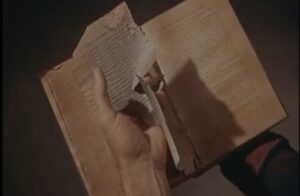
It is hard not to recall the famous scene in the 1960 film of H.G. Wells’s The Time Machine (starring Rod Taylor). When the time traveler is shown a vast library by one of the childlike Eloi, the books crumble to dust at his touch. The Eloi themselves have no idea what a library once was or why the books mattered. In the story, the Eloi are a dumbed-down remnant of humanity: gentle, incurious, and living in carefree ignorance on the surface, while the subterranean Morlocks control them, providing for their needs only to harvest them as livestock. The dumbing down of society and the quiet disappearance of physical books from our own shelves carries an uncomfortable echo of that moment.
The Elite College Students Who Can’t Read Books
An article in the Atlantic titled: “The Elite College Students Who Can’t Read Books” reported that many students arriving at highly selective colleges (Columbia, Georgetown, and others) are no longer prepared to read full books. Professors describe students who feel overwhelmed by the idea of finishing even one novel in a semester, struggle to track plot and detail over long stretches of text and often arrive from high schools that largely abandoned assigning complete books in favor of short excerpts and test-prep passages.[3]
Back in my dinosaur days the number of books to be completed in the school year corresponded with the grade level. For example, in eighth grade students were assigned at least eight books to read in that school year.
Farenheight 451 has arrived without the firemen.
My earlier fear is now reality. The same technological system that shortened attention spans and literacy is now destroying the physical books that once rewarded deep attention.
Who is doing it?
Anthropic, the company that builds the Claude models, carried out a large secret effort called Project Panama. Court records show the company hired Tom Turvey, the former head of partnerships for Google’s book-scanning project and gave him the job of obtaining “all the books in the world.” Anthropic spent tens of millions of dollars buying millions of used and print books, cut them apart, scanned the pages, and discarded the paper. A federal judge later ruled that destroying the legally purchased books after scanning them counted as fair use. Details of this operation appear in Washington Post reporting based on court filings: https://www.washingtonpost.com/technology/2026/01/27/anthropic-ai-scan-destroy-books/
A company called ISBNdb now sells the same service to other artificial-intelligence labs. Its website advertises bulk orders ranging from one thousand to one million books. It offers strict non-disclosure agreements so the buyer’s identity stays hidden. One of its own pages states that:
“‘AI company destroys two million books’ is not a headline that generates sympathy.”
ISBNdb promotes books printed before 2022 as clean training material free of AI machine-generated text. Investigative reporting by 404 Media in July 2026 documented how the pipeline works and how booksellers have noticed sudden large orders for obscure titles. AI Companies Are Buying Tons of Old Books Because They’re Free of AI Slop
Its marketing pages for this service can be read here: https://isbndb.com/blog/print-books-sourcing-ai-training/
Why they are doing it?
The open internet is filling up with text written by earlier artificial-intelligence systems, sometimes referred to as “AI Slop.” When new models train on that polluted material, their quality drops. Physical books printed before the current wave of chatbots remain one of the last large collections of pure human writing. By buying the books, scanning them, and destroying the paper copies, companies gain clean data while making it harder for anyone later to prove that the original physical volumes still exist. Unfortunately, the legal ruling in the Anthropic case lowered the risk for everyone else, so the practice is spreading.
Why is this so damaging?
It is obvious why this is so damaging when you hear the truth is exposed. They are not digitizing the books for posterity; digitization does not leave the original book intact on the shelf. This is a permanent loss that we cannot undo. The original object is destroyed. Rare or nearly unique copies of older works, technical manuals, botanical texts, local histories, out-of-print scholarship, are all at real risk. Books that survived wars, fires, floods, and centuries of careful handling are now being fed into industrial scanners so machines can produce slightly better marketing copy or chat replies.
Literacy already suffers when children lose the habit of sustained reading. Destroying the physical books removes the very objects that once invited that habit. History suffers when primary sources and scarce editions vanish. Cultural memory suffers when the tangible record of human thought is treated as disposable raw material. Calling the destruction “digital preservation” is false. True preservation keeps the original. This process eliminates it.
We already raised generations with shortened attention spans through constant visual switching in media and classrooms. Now the same system is quietly erasing the physical books that rewarded deep attention. The volumes still sitting on shelves today are not safe simply because they remain for the moment. Eventually all hard back and paper books could be eliminated no matter how old, rare or special they are.
This is Fahrenheit 451 without the firemen and without anyone holding a gun.
No one is forced to burn the books in public. They are purchased, cut, scanned, and shredded under non-disclosure agreements, then justified as progress and approved by the courts. The result is the same: fewer real books left in the world and a thinner record of the human mind for the next generation to discover.
Books are scanned and then destroyed in secret so AI can sound more human. That should alarm anyone who still values the physical page and the human creativity and history recorded on it.
Soma and the Feelies for the Modern Age
This also reminds me of the dystopian novel Brave New World. The technocrats have long believed themselves the wise elite destined to manage society. A dumbed-down and largely illiterate population is far easier to control by a Technate. When people lose the ability or desire to read deeply, they become more dependent on simplified explanations and official narratives/propaganda/revisionist history. Add to this a heavily medicated society: roughly one in four Americans takes psychiatric drugs, and millions of children are prescribed medications such as Ritalin. Many doctors have long referred to Prozac as the “I don’t care” drug because of the emotional blunting it can produce, just as Soma did in Huxley’s world.
Yet the Huxley novel offered another, equally potent instrument of control: the Feelies. These were not mere films but multi-sensory spectacles that flooded the audience with engineered pleasure, touch, scent, and sensation, rendering thought unnecessary and discontent impossible. Today we have our own Feelies: not only virtual reality but also endless streams of short-form video, algorithmic feeds, immersive gaming, and on-demand entertainment that keep the mind perpetually occupied and the nervous system constantly stimulated. The modern citizen, like the citizen of the World State, increasingly feels an almost physical need to be entertained without pause.
Citizens who feel less, care less, read less, and cannot bear to be unstimulated are far less likely to notice or resist when their freedoms are steadily removed. A population that is distracted, under-educated, chemically calmed, and addicted to perpetual sensation is the ideal subject for Technate Morlock to fully control.
I don’t know about you, but I am going to buy some more hardback classics for our library, just in case.
On a personal note: I am presently reading an old hardback (1859-1930 edition) of the Original Illustrated Sherlock Holmes series. It is interesting to note that the character of Sherlock Holmes by Arthur Conan Doyle is very different in most ways from the overacted and exaggerated Sherlock Holmes in all the different movies and tv series. Sherlock is kinder, gentler and not as arrogant as he is depicted in visual media. Modern portrayals often crank the eccentricity, the rudeness, and the “genius as social disability” angle up to eleven because it plays better on camera. The books don’t need that amplification. Although the tv series and movies are quite entertaining there still is nothing comparable to reading a good original novel.

[1] https://www.404media.co/ai-companies-are-buying-tons-of-old-books-because-theyre-free-of-ai-slop/
[2] https://www.publishersweekly.com/pw/by-topic/industry-news/libraries/article/95383-the-quiet-crisis-facing-u-s-public-libraries.html
[3] https://www.theatlantic.com/magazine/archive/2024/11/the-elite-college-students-who-cant-read-books/679945/