
Sweden just admitted what many of us have been shouting for years. Screens in school were sold as the future. They delivered falling literacy, fractured attention, and a generation that cannot sit with a book long enough to finish a thought.
The country that once rushed laptops into every classroom is now buying books by truckload. That is not nostalgia. That is damage control.
Sweden Hit the Brakes After the Experiment Failed
By the mid 2010s, about 80 percent of Swedish high school students had their own computer school device. Preschools were even told to use digital tools. The promise was simple. Prepare kids for a digital world. Get rid of the old paper. [1]
Then the scores dropped.
Sweden used to rank among Europe’s strongest readers. PISA (Program for International Student Assessment) scores fell hard in 2012, recovered a little, then dropped again in math and reading in 2022. Almost a quarter of 15 and 16 year olds could not reach a basic level of reading comprehension. Sweden performed worse in literacy than the UK, the US, Denmark and Finland.[2] [3]
According to Sweden’s Karolinska Institute there is clear scientific evidence that digital tools impair rather than enhance student learning. They said the focus should return to printed textbooks and teacher expertise, not unvetted digital sources. [4]
Teachers noticed it in the room. One teacher said most pupils cannot use computers without splitting their attention between playing, chatting and studying. The result is fatigue and substandard learning. Another said that when new textbooks arrived, the children loved the smell of the books. They wanted them. [5]
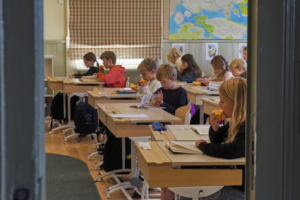
Picture of Swedish classroom returning to books, paper, pencils and handwriting. AP photo/David Keyton
From Screen to Binder, and They Are Spending Real Money to Do It
The government slogan is “från skärm till pärm.” From screen to binder.
Preschools are no longer required to use digital tools. Tablets are not given to children under two. A mobile phone ban in schools, even for so-called educational use, is coming into force. Schools already received more than 2.1 billion kronor, about 200 million dollars, to buy textbooks and teacher guides. A new curriculum built around textbook learning is due in 2028. [6] [7]
This is not a small course correction. This is a country that went all in on screens, watched literacy and concentration slide, and chose paper.
Students themselves are split. Some say they can focus better with books. Others still want more computers. Tech companies warn that Sweden will produce workers who cannot function in a digital economy. That argument only works if you pretend reading, writing, memory and attention are optional extras.
They are not extras. They are the foundation. Sweden’s education minister said it out loud. Digital competence requires basic skills first. Reading. Writing. Arithmetic. Then you build the rest. [8]
America Already Took the Same Road that Sweden Is Now Backing Off
This is not a Swedish problem with a Swedish solution. The United States went further. A New York Times survey of teachers found that 99 percent said their school provided devices to students for use in class. Eight in ten said students had a device assigned to them. Most of the country’s largest districts now hand out devices starting in kindergarten or earlier. Federal data shows 88 percent of U.S. public schools had a one-to-one computing program in the 2024-25 school year, and 96 percent of public schools said they had given digital devices to students who needed them after the pandemic scramble. American classrooms are saturated and seeing the same falling reading scores and the same distraction. The same one laptop per child gospel. Sweden is buying books back. Too many U.S. districts are still buying Chromebooks.[9] [10] [11]
Jump. Scroll. Click. Forget. This Is How Technology Dumbs Down Education
I have said this before and I will keep saying it. Technology does not make children smarter just because it looks modern. [12]
Unless we become Amish, which is probably a healthier lifestyle, the mastery of technology is essential for success and should be taught in schools. That does not mean handing a laptop to every child and calling it learning. Overuse of technology can dumb down education, increasing illiteracy and decreasing intelligent thought and brain capacity.
A screen is a distraction machine wearing a school uniform. Notifications, tabs, games, chats, autoplay. The child’s brain is still building the ability to hold one idea long enough to understand it. A device trains the opposite habit. Jump. Scroll. Click. Forget.
Use It or Lose It
Like a muscle that strengthens with exercise, the brain strengthens through learning and problem solving. Use it or lose it. When a child is handed a calculator before memorizing math tables, or spell check before learning to spell, or a keyboard before handwriting, the school is not saving time. It is skipping the work that builds the brain. It’s skipping the foundational learning needed for the future.
Most schools have reduced or eliminated cursive. Common Core did not require it. The focus shifted to keyboarding. That is unfortunate, because the intricate movements of cursive engage more brain areas than printing or typing. Today’s students also read very few books. That is Fahrenheit 451 via technology. [13]
Reading on paper is different in the brain. Reviews have found weaker comprehension on screens than on paper, especially with informational text. Handwriting forces the mind to slow down and encode. Typing does not do the same work. Heavy classroom computer use tracks with lower scores. Students who used computers more than six hours a day scored far lower on PISA than peers who did not. [14] [15]
We were told screens would close gaps. They often widen them. Weaker students get hit hardest by distraction. The children who most needed a teacher, a book, and silence got a glowing rectangle instead.
That is the dumbing down. Not because children are stupid. Because the environment we built for them makes deep work almost impossible.
Wi-Fried Classrooms Are an Experiment on Developing Bodies
Here is the part that still gets treated like a conspiracy even after Sweden, France, Israel and other countries started pulling wireless out of the youngest classrooms. [16] [17]
In the 1950s many shoe stores used X-ray machines so we could see the bones in our feet inside the shoe. It looked cool. It was a sales trick. It was phased out when people woke up to the radiation risk. We were clueless then, just as many are clueless now about repeated EMF exposure from routers, phones and classroom laptops.
The harm is often cumulative. Invisible. The public is being wi-fried slowly, like the frog in lukewarm water that comes to a boil too late to jump out and the damage is done.
Children are not small adults. Their skulls are thinner. Their brains have more fluid. Their tissues absorb more radiofrequency radiation from phones, tablets and classroom Wi-Fi than an adult body does. Compared with an adult male, a phone held against a child’s head exposes deeper brain structures to greater radiation per unit volume, and the young thin skull’s bone marrow absorbs a roughly 10-fold higher local dose. [18] [19] [20]
A classroom full of routers, laptops and phones is not a quiet background hum. It is a dense wireless field that pulses all day. Studies that measured Swedish schools with Wi-Fi found exposures that sat above precautionary levels independent scientists have recommended, even when they stayed under official heating based limits. Those official limits were written around avoiding cooked tissue. They have remained unchanged since 1996, when a flip phone was cutting edge. They were not written around a six-year-old sitting under an access point for six hours a day, year after year. [21]
The developing brain is still wiring itself. That is the last organ you want to bathe in an untested daily dose of microwave radiation while you also ask it to learn to read.
And it is not only the brain.
Young girls are born with all the eggs they will ever have. Microwave signals pass through the uterus into the ovaries. If those eggs are damaged, that damage cannot be repaired. The mitochondrial DNA in girls is irreparable. If that girl has a daughter, the daughter can carry the damage, and her daughter after her. This is not only about this generation. It is about the ones that follow.[22]
Barrie Trower, who trained as a radar specialist with microwave radiation in the British Royal Navy, has spent years warning that Wi-Fi should be banned from classrooms because children have an underdeveloped blood brain barrier, an immature immune system and less dense bones. Researchers reviewing pooled data on radiofrequency radiation have called for cell towers to be distanced from homes, daycare centers, schools, and places frequented by pregnant women and the young. [23] [24]
The American Academy of Pediatrics has already told parents to reduce children’s cell phone radiation. Environmental groups have argued that children’s exposure limits should be hundreds of times stricter than the old federal numbers still on the books. Several countries restricted or banned Wi-Fi in kindergartens and early grades for a reason.
Call it precaution. Call it common sense. Do not call it anti-technology. Wired internet exists. Books exist. Pencils exist. None of those require a router over a seven-year old’s head.
Turn airplane mode on when a phone is near a pregnant abdomen. Do not put a live phone in a pocket or a bra. Turn the Wi-Fi off at night. Better yet, use ethernet and a landline at home. Children cannot turn off the school router. Adults can demand that schools stop treating childhood as a product test.
The Tech Industry Will Call This Backward. The Test Scores Call It Honest
Critics say Sweden is risking its economy. They point to Spotify and the country’s tech reputation. They say most jobs will need digital skills despite tech moguls revealing that most digital jobs will be taken over by AI in the future.
Teach digital skills when the child can already read a paragraph without a pop up eating the sentence. Teach coding after handwriting has trained the hand and the memory. Teach AI after the student can tell a true sentence from a generated one.
Sweden is not banning computers from adult life. It is refusing to keep using childhood as a product demo.
Other places are moving the same way. Phone bans are spreading. Los Angeles is pulling devices from the youngest grades. States are putting limits on classroom screens. Parents who were told they were overreacting now have PISA charts and empty school libraries as evidence. [25]
The experiment had a control group. It was called a book.
What Parents Should Demand Tomorrow Morning
Ask your school three questions.
How many hours a day is my child on a screen for so-called learning?
Is the internet wired, or is the classroom a Wi-Fi bath?
Where are the textbooks?
If the answers are “most of the day,” “wireless everywhere,” and “we went paperless,” you already know what Sweden found out the expensive way.
Get the phones out of the school day. Put books back on the desk. Use cables instead of antennas where children sit. Protect the developing brain. Protect the developing body. Stop pretending that a glowing slab is a teacher.
Sweden spent years digitizing childhood and then had to buy the books back. America ran the same experiment at even larger scale. We do not have to keep running it just to look modern.
The children cannot vote. They cannot leave the room. They cannot turn off the router over their heads. That is our job as parents. Demand safety and real learning in the classroom.
[1] https://www.bbc.co.uk/news/articles/cly0vk77vdko
[2] https://www.bbc.co.uk/news/articles/cly0vk77vdko
[3] https://www.oecd.org/en/publications/pisa-2022-results-volume-i_53f23881-en.html
[4] https://apnews.com/article/sweden-digital-education-backlash-reading-writing-1dd964c628f76361c43dbf3964f7dbf4
[5] https://courier.unesco.org/en/articles/sweden-unmet-promises-digital-classroom
[6] https://www.bbc.co.uk/news/articles/cly0vk77vdko
[7] https://www.government.se/articles/2024/02/government-investing-in-more-reading-time-and-less-screen-time/
[8] https://courier.unesco.org/en/articles/sweden-unmet-promises-digital-classroom
[9] https://www.nytimes.com/2025/11/12/upshot/teachers-survey-chromebooks-class.html
[10] https://www.kqed.org/news/12096557/a-chromebook-in-the-hand-of-every-child-did-schools-go-too-far
[11] https://apnews.com/article/school-screen-time-technology-edtech-07958fb159c7cfbceb7bfdb37b2bb726
[12] https://glorytogodstudio.com/commentary/the-dumbing-down-of-education-through-technology/
[13] https://glorytogodstudio.com/commentary/the-dumbing-down-of-education-through-technology/
[14] https://www.theguardian.com/education/2026/aug/16/neuroscientist-screen-use-schools-educational-technology-jared-cooney-horvath
[15] https://www.nbcnews.com/news/education/digital-delusion-book-jared-cooney-horvath-screens-schools-rcna345869
[16] https://glorytogodstudio.com/commentary/wi-fried/
[17] https://ehtrust.org/catalyst-wi-fried-documentary-about-children-and-wi-fi-radiation/
[18] https://glorytogodstudio.com/commentary/wi-fried/
[19] https://ehtrust.org/health-effects-of-wi-fi-technology-in-schools/
[20] https://www.ewg.org/news-insights/news/2022/11/protecting-kids-wireless-radiation-school-and-home
[21] https://www.frontiersin.org/journals/public-health/articles/10.3389/fpubh.2017.00279/full
[22] https://glorytogodstudio.com/commentary/wi-fried/
[23] https://glorytogodstudio.com/commentary/wi-fried/
[24] https://www.ewg.org/news-insights/news-release/2021/07/study-wireless-radiation-exposure-children-should-be-hundreds
[25] https://apnews.com/article/school-screen-time-technology-edtech-07958fb159c7cfbceb7bfdb37b2bb726